We are nearing the end of another year of studies here at Namdroling. My last class will be next Monday morning, which is the Buddhist holy day Lhabab Duchen and thus a very auspicious day to complete our endeavors. There will then be eleven days of break and perhaps pujas for His Holiness' swift rebirth. The next week will usher in that time which is my most favorite as well as most stressful - Reading Month aka. rangjong - the independent study period before exams.
For a few days this week I was the one and only foreign student residing at this monastery. My good friend D. has left, at least temporarily, and M.L. is also off site. Yesterday, however, I noticed a Chinese nun has arrived, so I'm no longer the only international student, not that it matters much, really. I rarely think of my self as being 'other' while living here amongst the nuns. I asked my classmates once, "Do you see me as your classmate or as a foreigner?" They replied, "When we see you from far away, we see a foreigner. When we see you up close we see our classmate."
Showing posts with label nunnery. Show all posts
Showing posts with label nunnery. Show all posts
Friday, November 06, 2009

Sunday, October 11, 2009
Changes at our nunnery
What was once: Is now:

 Instead of:

Although... Hmmm....
The last two images are courtesy of the Library of Congress Archives.
Is now:And now we see:
Which is hopefully laying the ground for:Instead of:Although...
Hmmm....The last two images are courtesy of the Library of Congress Archives.
Wednesday, March 14, 2007
What does the nunnery look like?
 Nuns on their way to puja in the nunnery temple. On the second floor there is a library and two classrooms.
 The shedra building to the left of the main temple. This building houses nuns studying in the philisophical college.
 The new building to the left of the shedra building. This building houses mainly dratsang nuns, primary school nuns and a few shedra nuns. There are five classrooms in the left wing.
Thursday, January 18, 2007

Saturday, December 30, 2006

Saturday, November 25, 2006
Saturday, October 28, 2006
Friday, October 27, 2006
What happens in a Tibetan monastery?
Our community at Namdroling is composed of a monastery with at least 3000 monks and a nunnery with just over 500 nuns. Both the monastery and nunnery have three main parts: primary school (lobtra), ritual arts college (dratsang), and philosophical college (shedra). The monastery also has a three year retreat center (drubdra) and the nunnery hopes to build one as soon as sponsorship is available.
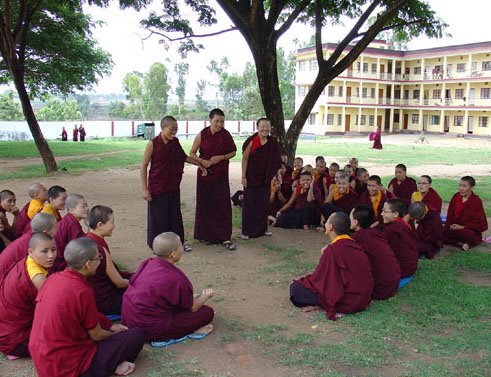
The lobtra provides an eight year school program for children between the ages of seven and twenty-two (approximately). All classes are taught in Tibetan. Subjects include reading, writing, chanting, and English in the early years. Later years also study basic Buddhist texts, debate, ritual arts, and ritual music. This type of primary education prepares students to enter the shedra or dratsang after graduation. The students take the monastic robes and thus become monks and nuns, but usually do not take novice vows until after graduation.
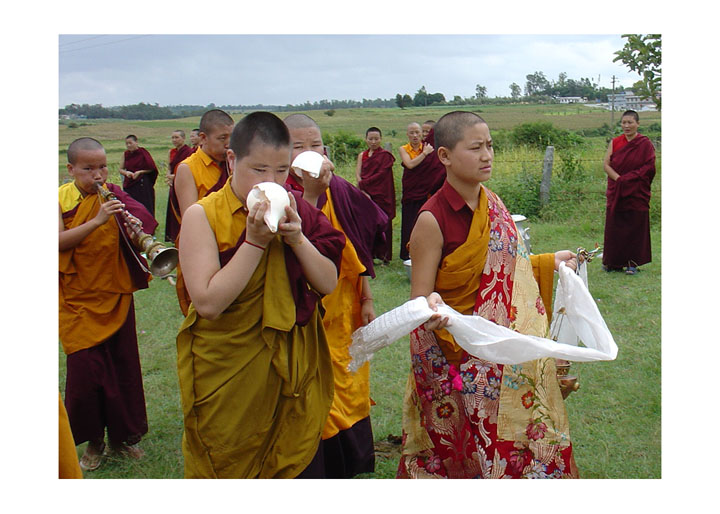
The dratsang is home to the greatest percentage of the monastery population. The dratsang's main occupation is to carry out liturgical services (puja). Pujas are performed within the monastery's temples and also within the private homes of the local laity. Dratsang monks and nuns study litugical chanting, the making of ritual substances, and playing liturgical instruments.
The shedra offers a nine year program in Buddhist philosophy. Students study 6 to 8 texts each year. They debate for an hour each day, and write comprehensive final exams at the end of the year. Since this is where I study, it will be the subject of many future blogs.
The drubdra is a retreat center where participants practice in a sealed group retreat for three years, three months and three days.
There are many different teachers in the monastery. Foremost is our revered abbot and spiritual guide, His Holiness Penor Rinpoche. His Holiness offers empowerments and meditation instruction as well as practical advice to the monks, nuns, and laity. Graduates of the shedra, lopons and khenpos, teach in the shedra and lobtra. A senior lama offers instruction inside the drubdra. And as is traditional, many older monks and nuns teach the younger ones and offer guidance based on their experience.
Another essential part of the monastery community is the large number of monks and nuns who serve as 'workers'. They cook, build, oversee sections of the monastery or specific projects, and maintain discipline. Some workers hold their positions permanently, but most are appointed to serve for three years.
All members of the monastery may engage in their individual practices of prayer and meditation. There are also group practices and retreats held every year.
The lobtra provides an eight year school program for children between the ages of seven and twenty-two (approximately). All classes are taught in Tibetan. Subjects include reading, writing, chanting, and English in the early years. Later years also study basic Buddhist texts, debate, ritual arts, and ritual music. This type of primary education prepares students to enter the shedra or dratsang after graduation. The students take the monastic robes and thus become monks and nuns, but usually do not take novice vows until after graduation.
The dratsang is home to the greatest percentage of the monastery population. The dratsang's main occupation is to carry out liturgical services (puja). Pujas are performed within the monastery's temples and also within the private homes of the local laity. Dratsang monks and nuns study litugical chanting, the making of ritual substances, and playing liturgical instruments.
The shedra offers a nine year program in Buddhist philosophy. Students study 6 to 8 texts each year. They debate for an hour each day, and write comprehensive final exams at the end of the year. Since this is where I study, it will be the subject of many future blogs.
The drubdra is a retreat center where participants practice in a sealed group retreat for three years, three months and three days.
There are many different teachers in the monastery. Foremost is our revered abbot and spiritual guide, His Holiness Penor Rinpoche. His Holiness offers empowerments and meditation instruction as well as practical advice to the monks, nuns, and laity. Graduates of the shedra, lopons and khenpos, teach in the shedra and lobtra. A senior lama offers instruction inside the drubdra. And as is traditional, many older monks and nuns teach the younger ones and offer guidance based on their experience.
Another essential part of the monastery community is the large number of monks and nuns who serve as 'workers'. They cook, build, oversee sections of the monastery or specific projects, and maintain discipline. Some workers hold their positions permanently, but most are appointed to serve for three years.
All members of the monastery may engage in their individual practices of prayer and meditation. There are also group practices and retreats held every year.
Saturday, October 21, 2006
What led you to become a Buddhist nun?
I was born in Saskatoon, Saskatchewan, Canada. I attended Greystone Heights Elementary School and Walter Murray High School. In my last year of high school I encountered Buddhism when my father invited me to see a performance by some Tibetan lamas. I found the performance interesting and it started me reading books about Buddhism. I discovered that Buddhism provided answers about life which felt true to me.
As a graduation gift, I was able to visit Vancouver, and I took that chance to formally become a Buddhist by taking refuge.
A few months later I met Venerable Karma Lekshe Tsomo, the founder of Sakyadhita, she gave me the opportunity to teach English at Jamyang Choling Monastery for Women in Dharamsala, India. I taught English at Jamyang Choling for 4 months in 1999. I greatly admired the life the nuns led. They seemed very pure hearted, joyful, and free of worldly concerns.
A few months later I met Venerable Karma Lekshe Tsomo, the founder of Sakyadhita, she gave me the opportunity to teach English at Jamyang Choling Monastery for Women in Dharamsala, India. I taught English at Jamyang Choling for 4 months in 1999. I greatly admired the life the nuns led. They seemed very pure hearted, joyful, and free of worldly concerns.
Although I wished to become ordained immediately, there didn't seem to be a community where I could live, and there were other obstacles, so I returned to Canada. It turned out to be very beneficial to wait a few years before ordaining. I was able to consider the decision deeply, and help my family become comfortable with the idea.
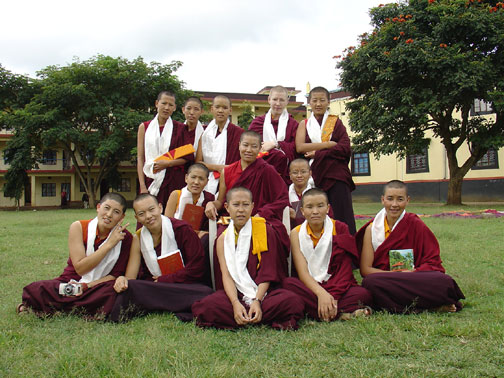
I came to Namdroling Monastery in South India in 2001. I received the ceremony of 'going forth' from Khenchen Pema Sherab. In May of 2002, I received novice vows from His Holiness Penor Rinpoche, the abbot of the monastery. I have been living at Namdroling since that time. In 2004 I joined the nuns philosophical college (shedra), Tsogyal Shedrup Gawa'i Tsal.
Subscribe to:
Posts (Atom)


